Hume Body Pod: Specs, Accuracy Research, and What to Know Before You Buy
The Hume Body Pod is a smart scale that estimates body composition, not just weight. Like most body composition scales, it uses bioelectrical impedance analysis (BIA): it sends a small electrical current through your body and estimates fat, muscle, and water from how easily the current passes. Unlike most bathroom scales, it adds handheld grips, so the current runs through your arms and torso as well as your legs. That gives it more to work with than an adult BMI calculator, which only uses height and weight.
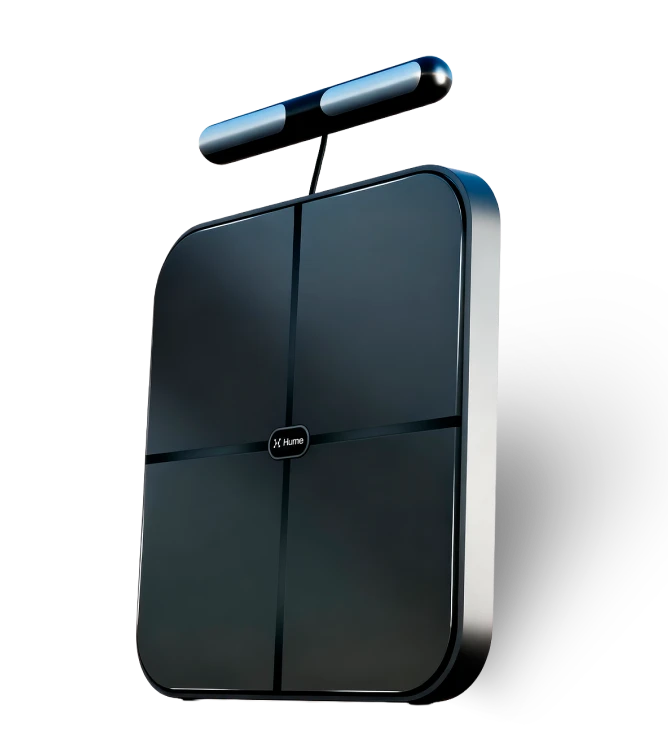
Product image: Hume Health
Hume lists the Body Pod as HSA/FSA eligible and advertises a 45-day money-back guarantee.
Check price on HumeHealth.com →Why body composition can tell you more than BMI
BMI is a useful screening tool, but it only uses height and weight. It cannot tell you whether you are losing fat or muscle. A body composition scale estimates those separately, which can help when the number on a regular scale stops moving even though your body is changing.
The trade-off is that every BIA scale estimates body composition indirectly. An NIH technology assessment panel found that BIA readings are affected by hydration, recent food and drink, recent exercise, body position, and skin temperature, and that reliable results depend on keeping those conditions consistent. In practice, that means weighing in at the same time of day, under the same conditions, and paying more attention to trends than to any single reading.
How accurate is it? What independent research found
Hume describes the Body Pod's accuracy in several different ways on its own website: "98% DEXA accuracy," a "98% correlation" with DEXA, and readings within ±2% or ±3% of a DEXA scan, citing a study by a lab called Socotech. We could not find that study's methods or full results published, so we can't assess those claims.
There is an independent study. In 2026, researchers at Texas Tech University's Energy Balance & Body Composition Laboratory bought a Hume Pod and tested it on 67 adults against two lab reference methods: a DXA scan and a four-compartment model, which combines several lab measurements and was the study's main reference standard. The authors report that they received no outside funding for the project. The study was posted as a preprint on medRxiv and has not yet been peer-reviewed. They found:
- Close to the four-compartment model on average. Body fat percentage differed by 0.6 percentage points on average, with an average error of 2.6 points for an individual reading.
- Slightly lower than DXA. The Hume Pod read body fat about 1.8 percentage points lower than DXA on average (27.1% vs. 28.9%), with an average individual error of 3.0 points.
- Consistent repeat readings. Back-to-back measurements typically differed by less than 1 percentage point of body fat.
- Among the better consumer devices tested. The same lab previously tested 14 consumer BIA scales. The Hume Pod's results were similar to, and slightly better than, the best of those (the InBody H2ON).
Two caveats matter. First, "2.6 points on average" is an average: for any one person, the study's 95% limits of agreement were about ±6 percentage points of body fat, so an individual reading can still be off by more than that average. Second, the repeat readings were taken during a single lab visit, so the study doesn't show how well the scale tracks small changes over weeks or months at home.
Key features, as described by Hume
The features below come from Hume Health's product listing. We have not verified them ourselves.
45 body composition metrics
Body fat, muscle mass, visceral fat, subcutaneous fat, bone mass, body water, metabolic age, and more.
8-electrode, multi-frequency BIA
Electrodes in the platform and the handheld grips, measuring at multiple frequencies.
Segmental scan
Separate estimates for the torso, arms, and legs, rather than the legs only as with foot-only scales.
Free app with optional coaching
Hume says core tracking in its app is free; coaching and some other features are a paid add-on.
Health app sync
Hume lists syncing with Apple Health, Google Health Connect, Fitbit, Garmin, and other platforms.
Multiple users
Up to 24 user profiles, each with their own Hume account.
What the metrics mean
A body composition scale reports many numbers. These are the ones most people pay attention to:
| Metric | Why it matters |
|---|---|
| Body fat % | Shows how much of your weight is fat, which is more informative than weight alone. |
| Visceral fat | Fat stored around the organs in the abdomen, which is linked to a higher risk of chronic disease. |
| Muscle mass | Helps show whether weight loss is coming from fat or from muscle. |
| Metabolic age | A manufacturer-defined score comparing your estimated metabolism with typical values for your age. Best treated as a rough indicator. |
| Body water | Helps separate real fat loss from day-to-day water fluctuations. |
| Bone mass | An estimate only. A scale can't replace a clinical bone density scan. |
How a measurement works
Based on Hume's instructions:
- Step on the scale barefoot, on a flat and uncarpeted surface, with the Hume Health app open on your phone.
- Hold the handles at waist height while standing upright until the scan finishes. Hume says this takes about 90 seconds.
- View your results in the app.
- Track trends over time rather than reacting to a single reading. For the most consistent results, measure at the same time of day, under the same conditions.
How it compares to other ways of measuring body composition
| Hume Body Pod | Foot-only smart scale | DXA scan | |
|---|---|---|---|
| How it measures | Hand-and-foot BIA: current through arms, torso, and legs | BIA: current through the legs only | Low-dose X-ray |
| Where | At home | At home | Clinic or lab |
| How often you can use it | Daily | Daily | Occasionally |
| Accuracy | Tested well in one independent study | Varies widely between models | Common clinical reference |
The Texas Tech researchers stress that accuracy varies a lot even between scales that look alike, so results for one model shouldn't be assumed for another.
Strengths and trade-offs
Strengths
- Independent (not yet peer-reviewed) research found accuracy among the best of consumer BIA scales tested
- Hand and foot electrodes measure the upper body, not just the legs
- Consistent back-to-back readings in that research
- Hume lists a free app, sync with major health platforms, and up to 24 user profiles
- Hume advertises a 45-day money-back guarantee, so you can try it
Trade-offs
- Costs more than basic smart scales
- You have to hold the handles for each full scan
- Like any BIA scale, readings shift with hydration, meals, and exercise
- In the independent study, it read body fat slightly lower than DXA on average
- Coaching features require a paid subscription
- BIA scales are not for everyone with an implanted medical device (see FAQ)
Specifications
As listed by Hume Health:
| Spec | Details |
|---|---|
| Weight range | 5–200 kg (9–400 lbs), 50 g precision |
| Platform | High-strength tempered glass, 12.7 × 12.7 in. |
| Display | 2.8" graphical display |
| Connectivity | Bluetooth & Wi-Fi |
| Battery | Rechargeable Li-ion, up to 1 year per charge |
| Sensors | 4 weight sensors + 8-electrode BIA + heart rate |
| Users | Up to 24 profiles |
| Warranty | 1-year included (10-year optional) |
Who might want one
A hand-and-foot body composition scale like the Hume Body Pod makes the most sense if you:
- Want to see whether you are losing fat or muscle, not just weight
- Are training or dieting and the number on a regular scale isn't telling you much
- Will weigh in regularly and under consistent conditions, so trends are meaningful
- Want frequent at-home estimates between occasional clinical measurements
If you only want to track weight, a basic scale is enough. If you need precise measurements for a medical decision, ask your doctor about a clinical test such as DXA.
Hume Body Pod FAQ
Has GSFTEK tested the Hume Body Pod?
No. This page is an overview based on Hume Health's published information and independent research, which are linked above.
How accurate is the Hume Body Pod?
In an independent 2026 study from Texas Tech University (a preprint that has not yet been peer-reviewed), the Hume Pod's body fat estimates for 67 adults were within 0.6 percentage points of a four-compartment reference model on average, and about 1.8 points lower than DXA on average. Individual readings can still differ by several points. Hume's own claims of 98% accuracy and ±2–3% of DEXA cite a Socotech study whose full results we could not find.
Is the Hume Health app free?
Hume says you can track your body composition metrics in the app at no cost, with coaching and some other features available as a paid add-on.
Does it sync with Apple Health and Fitbit?
Hume lists syncing with Apple Health, Google Health Connect, Fitbit, Garmin, and other platforms.
Can multiple people use one Hume Pod?
Hume says the scale supports up to 24 user profiles, each with their own Hume account.
Is BIA safe?
BIA scales send a very small electrical current through the body. If you have a pacemaker, implanted defibrillator, or other implanted electronic medical device, check with your doctor before using any BIA scale.
What if I don't like it?
Hume advertises a 45-day money-back guarantee. Check the current terms on Hume's website before buying.
Is the Hume Body Pod HSA/FSA eligible?
Hume lists it as HSA/FSA eligible. Confirm with your plan administrator before buying with those funds.
How does this compare to using a BMI calculator?
A BMI calculator gives you a single number based on height and weight. A body composition scale estimates fat, muscle, and water separately, which gives a fuller picture, but those estimates come with the measurement limits described above.
Bottom line
On paper, the Hume Body Pod is a well-specified body composition scale, and the one independent study so far suggests it is more accurate than most consumer BIA scales. That study is not yet peer-reviewed, and Hume's own accuracy claims are not backed by published data we could find. Like any BIA scale, it is best for tracking trends under consistent conditions, not for precise one-off measurements.
If that is what you are looking for, the Hume Body Pod is worth a look, and the advertised 45-day return window lets you see how its readings work for you.
Check availability on Hume Health
Visit Hume Health →Medical disclaimer
This page is for general educational purposes only and is not a substitute for professional medical advice, diagnosis, or treatment. Body composition metrics should be interpreted alongside guidance from a qualified healthcare provider. Always consult your doctor before making health decisions, especially if you have a medical condition or an implanted medical device.